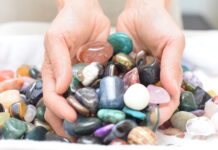

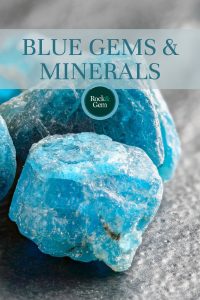
Blue gems and minerals are must-haves for lapidaries and hobbyists alike. Blue gems comprise a large percentage of colored gemstones, whether transparent or opaque.
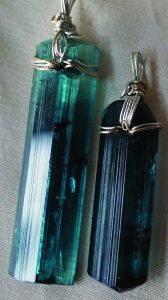
Transparent gemstones are commonly faceted, carved, or cut as faceted beads. Opaque gemstones are mostly cut en cabochon, carved and cut as beads in many shapes and styles. Almost every mineral group contains at least one blue member: corundum (blue sapphire), quartz (chrysocolla in quartz), tourmaline (indicolite), beryl (aquamarine), topaz, spinel, apatite, and zircon.
Blue Gems in the Spotlight: Color Trends
Blue gemstones grabbed the spotlight in 2020 when the Pantone® Color Institute’s Color of the Year was Classic Blue. Their description for Classic Blue states, instilling calm, confidence and connection.
In recent years, the colors of jewelry fashion are influenced by fashion color trends in clothing, textiles, furniture and home décor. The ideas flow from the runways to the stores. And a driving engine for this movement has been Pantone.
Classic Blue Gems for Jewelry
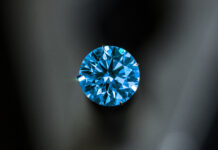
Besides the ideal option for Classic Blue being blue sapphire, other transparent blue gemstones fit that color shade, such as blue spinel and blue tourmaline. Buyers have to really know or trust that what they are purchasing is what they thought. Once faceted, blue gemstones with similar colors are very difficult to identify visually.
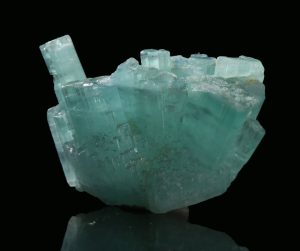
The Gemmological Association of Great Britain (Gem-A) recently set up a “Blue Stone Detective” challenge. It features eight blue gemstones along with flashcards. The hints focused on luster, refractive index, or dichroism properties. The eight blue gemstones were blue sapphire, glass, blue spinel, synthetic blue spinel, iolite, blue topaz and zircon. The challenge was a great reminder of how difficult it is to visually identify faceted blue stones, without clues or instruments.
Opaque Gems – Azurite
The description for Classic Blue matches precisely the rich colors of azurite and lapis lazuli. They are both ancient, timeless gemstones that have been used as lapidary materials and as ground pigments for personal adornment and murals over the centuries.
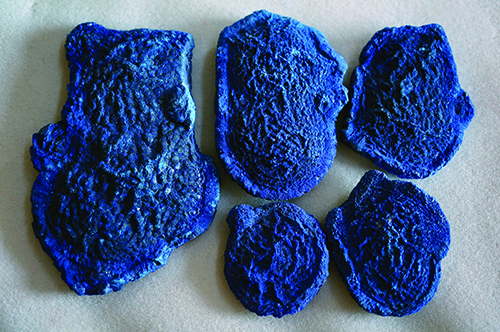
Azurite is a deep blue-colored copper mineral, with the chemical formula Cu3(CO3)2(OH)2. Azurite crystals form as dark blue prismatic crystals, but more commonly, azurite is found in a massive nodular or stalactitic form. It is very soft, only 3.5-4 on the Mohs scale. Stunning azurite crystals come from copper mines worldwide, including deposits in Morocco, Namibia, Hungary, Greece, Mexico, and of course, Arizona.
Azurite as a Lapidary Material
Lapidaries use azurite in various forms. When the material is solid, it can be cut and highly polished. Azurite from the legendary Bisbee and Morenci copper mines in Arizona is known to be the most solid, and therefore, the most sought-after.
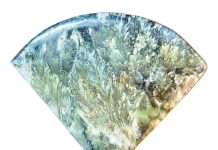
Azurite often shows a unique rosette structure of tiny prismatic crystals moving around in different directions within the surface. It can be cut just like other drusy material, leaving the drusy surface in the center untouched and polishing the surrounding surfaces. Some of the azurite crystals within the drusy surfaces are completely small crystals with very high luster and some translucency, such as the specimens from the Morenci Mine and the mined-out Milpillas Mine, in Sonora, Mexico.
Also popular are the azurite “balls,” usually cut or split in half to reveal their crystallized interiors. Beautiful azurite balls come from the famous Morenci Mine, in Greenlee County, Arizona.
Azurite “suns” from Australia (Malbunka Copper Mine, Western Aranda County, Areyonga, Northern Territory) exhibit a radiating structure and a beautiful texture with high ridges.
Azurite frequently forms together with malachite, which is often a pseudomorph replacement of azurite and may display spectacular sunbursts or drusy. The two natural minerals make a stunning visual arrangement when cut together as a gemstone, often with a combination of drusy and polished surfaces.
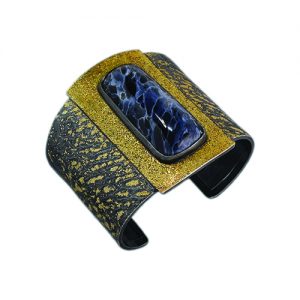
Classic Blue Pietersite
Classic Blue also matches the beautiful blue pietersite from Namibia. Pietersite is a form of chalcedony with embedded fibers of amphibole minerals and varying degrees of alteration. The fibers cause chatoyancy, similar to what’s seen in tiger’s eye, but tiger’s eye is not made of chalcedony, but macrocrystalline quartz.
Pietersite was discovered in 1962 by Sid Pieters in Namibia, hence its name. It is usually found with blue coloration and swirls of gold, brown, and rusty red hues.
Frequently Asked Questions About Blue Gems
What are blue gems?
Blue gems are gemstones and lapidary minerals that display blue coloration, ranging from pale sky blue to deep, saturated navy. They may be transparent, translucent, or opaque and occur across many mineral groups.
Are opaque blue stones considered gemstones?
Yes. Opaque blue materials such as azurite, lapis lazuli, and pietersite are widely accepted as gemstones when they are cut, polished, or carved for jewelry and ornamental use.
What blue gems are best for lapidary work?
Many blue gems are popular with lapidaries, including azurite, pietersite, lapis lazuli, and blue tourmaline. Suitability depends on hardness, stability, and whether the stone is best faceted or cut as a cabochon.
Why are so many gemstones blue?
Blue coloration in gemstones is often caused by trace elements such as iron, copper, or titanium, or by crystal structure and light interaction. These factors occur in many mineral families, making blue one of the most common gemstone colors.
This blue gems and minerals list appeared in Rock & Gem magazine. Click here to subscribe. Story and photos by Helen Serras-Herman.