
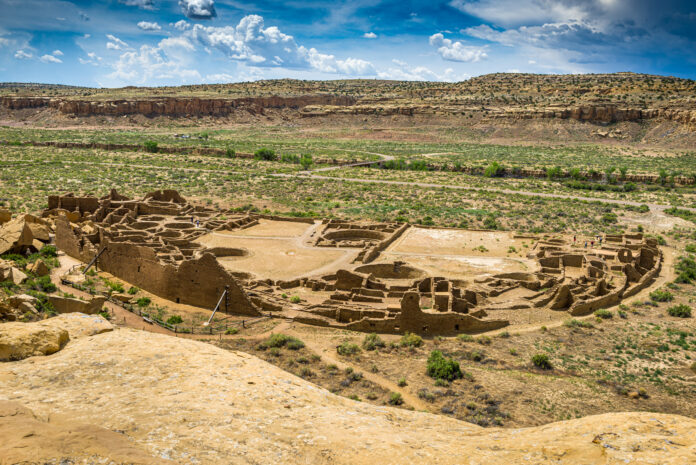
Chaco Canyon became the birthplace of America’s fascination with turquoise after a remarkable archaeological discovery in 1898 brought national attention to the gemstone.
The Turquoise Treasure of Chaco Canyon
While excavating 1,000-year-old stone ruins in remote Chaco Canyon, archaeologists recovered more than 50,000 turquoise artifacts, mostly beads, pendants and inlay. Their finds included “… a small burial room with 24,932 turquoise beads and more than 700 turquoise pendants. One skeleton had a total of 5,891 beads and several pendants of turquoise. Another had 8,385 beads and more than 500 pendants.”
As newspapers headlined the story of Chaco Canyon’s “turquoise treasure,” demand for turquoise began to soar. The blue-green gemstone was now forever linked to the mystique of a pre-Columbian Native American culture. It gained recognition as the Southwest’s iconic gemstone.
The ruins that yielded this turquoise treasure, now protected within Chaco Culture National Historical Park, are both the material legacy of the Ancestral Puebloan culture and the birthplace of America’s ongoing love of turquoise.
latintrotter/Adobe Stock
The Chaco Phenomenon
With marginal rainfall and little agricultural potential, northwestern New Mexico would seem an unlikely place to support a major pre-Columbian cultural center. But around 850 C.E., for reasons still unexplained, the Ancestral Puebloans who inhabited this area embarked upon an accelerated period of social development that anthropologists call the “Chaco Phenomenon.”
The Chaco Phenomenon was marked by complex community life and social structure, construction of extensive road systems, and establishment of far-reaching trade networks. Most impressive was its monumental architecture that featured massive, multistory stone buildings called great houses, each containing hundreds of rooms. By 1050, Chaco Canyon had become the region’s ceremonial and economic center. But around 1150, a number of factors, including extreme drought, brought about the abandonment of Chaco Canyon.
Turquoise in the Southwest and Chaco Canyon
Native American reverence for turquoise originated among Mesoamerican cultures around 500 B.C. and gradually spread northward. Turquoise was rare in Mesoamerica, where it was valued as a precious stone. But it was much more common in what is now the American Southwest and by 600 C.E., tribes in southern New Mexico and Arizona had begun trading turquoise to cultures in Mesoamerica.
The beginning of the Chaco Phenomenon coincided closely with the start of large-scale, systematic mining of the great turquoise deposit at Cerrillos, 100 miles southeast of Chaco Canyon and near present-day Santa Fe. Anthropologists suggest that the ready supply of high-quality Cerrillos turquoise was a major factor in launching the Chaco Phenomenon.
By 950, Chaco Canyon had become the premier source for finished turquoise and the starting point of a high-volume trade that extended across the Southwest and deep into Mexico. With few other available resources at Chaco Canyon, fabricating and trading turquoise beads, pendants and inlay was of critical economic importance.
Working Turquoise at Chaco Canyon
Chaco Canyon’s lapidaries shaped rough turquoise with flaked chalcedony tools. They polished it by repetitive rubbing with a fine, quartz-sand paste. But the most laborious step in fabricating beads and pendants was drilling. Modern lapidaries believe that Chacoans began drilling beads with flaked, pointed awls of chalcedony, then rotated sharp, thin bone fragments and feather or porcupine quills in a sand paste to complete the tiny perforations.
In tests that replicated this process, archaeologists spent 15 minutes drilling a single, disc-shaped, three-millimeter-diameter bead. While experienced Chacoan lapidaries were doubtlessly faster, their estimated cumulative production of more than one million beads and pendants represented an enormous investment in time.
The value of a turquoise bead was not vested primarily in turquoise itself, but in the time spent drilling. Chacoans traded these turquoise beads as what modern-day marketers would call a “value-added” commodity.
National Park Service Jim Ekstrand/Adobe Stock
The Turquoise Trade of Chaco Canyon
Chacoans used some turquoise for funereal purposes. Most was traded to cultures far to the south in exchange for copper bells, cotton, macaw feathers, mother-of-pearl seashells and other exotic commodities. They likely traded these in turn to neighboring tribes for food, timber, and other necessities.
Until recently, archaeologists had been unable to determine the origin of turquoise. They assumed that Chacoans worked only with Cerrillos turquoise. But advanced methods of chemically sourcing turquoise now suggest otherwise. Analysis of Chaco Canyon artifacts reveals that a substantial amount of turquoise actually came from sources as distant as Nevada.
Archaeologists now conclude that Chaco Canyon engaged in a two-way turquoise trade. Rough turquoise was imported from wherever it was available. Finished beads, pendants and inlay were exported.
Chaco Canyon FAQ
Why is Chaco Canyon associated with turquoise?
Chaco Canyon is associated with turquoise because archaeologists uncovered tens of thousands of turquoise beads, pendants, and inlay during excavations, revealing its central role in ancient trade and craftsmanship.
Where did the turquoise used at Chaco Canyon come from?
Much of the turquoise worked at Chaco Canyon came from the Cerrillos mining district in New Mexico, though chemical analysis shows that Chacoans also imported turquoise from distant sources, including Nevada.
How was turquoise used by the people of Chaco Canyon?
Turquoise was primarily fashioned into beads, pendants, and inlay that were traded across the Southwest and into Mesoamerica in exchange for food, raw materials, and luxury goods.
Chaco Today
Chaco Canyon National Monument was established in 1907. The National Park Service constructed a visitor center in 1953. Then, it expanded the monument in 1980 and renamed it Chaco Culture National Historical Park. In 1987, UNESCO listed the park as a World Heritage Site.
Despite its great cultural, architectural and archaeological significance, Chaco Canyon’s 42,000 visitors per year make it one of the least-visited national parks. One reason is its remote location, 60 miles south of Bloomfield, New Mexico, the nearest town of any size. Another is the graded-gravel access roads, which, depending on weather, can be bone-jarring washboards or muddy mires.
But the journey is well worth it to see the ruins of Chaco Canyon—the place where America’s love of turquoise was born.
This Rock Science column appeared in Rock & Gem magazine. Click here to subscribe. Story by Steve Voynick.