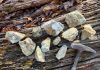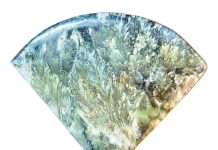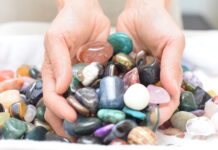

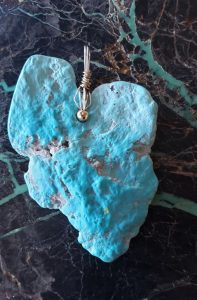
The all-natural turquoise color with no visible inclusions is highly prized and appreciated for its exquisiteness and rarity. However, only a small percentage of turquoise’s world production shows no inclusions. Most natural turquoise color exhibits a multitude of mineral inclusions.
How Inclusions Affect Turquoise Color
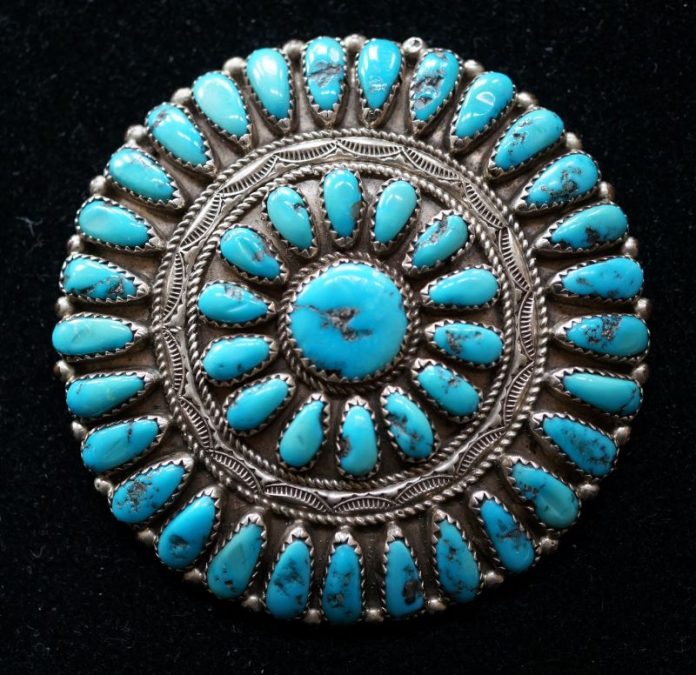
Turquoise is an aluminum phosphate and owes most of its blue color to copper. Additional minerals in its composition include aluminum, iron, manganese and zinc, which may give turquoise a greenish or brownish hue. Turquoise occurs as nuggets, botryoidal formations and veins. It may also be intermixed with the matrix host rock, which can be brown, black, gray, white, or red and create running veins, spiderweb, or eggshell patterns.
Additional mineral turquoise color inclusions may consist of quartz, feldspar, pyrite, silver, iron, black chert, brown or yellow limonite, clay and manganese or iron oxide dendrites. Some appear in perfect crystal shapes, such as hexagonal quartz crystals or square pyrite cubes. These distinctive inclusions can serve as indicators of natural-origin material and may even point to the origin of specific mines. These nature’s hallmarks add to the individuality and vividness and make outstanding, memorable gemstones.
Understanding Turquoise Stabilization Methods
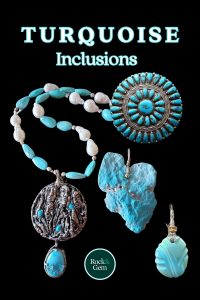
Turquoise varies in porosity and hardness between 5 and 6 on the Mohs scale. Softer stones can be stabilized with resins to make them hard and durable enough to be cut and polished. Stabilization is an acceptable trade treatment for porous, often lower-quality material, but when blue dyes are induced, disclosure is necessary. Another proprietary enhancement method is the Zachery Method. It requires better quality turquoise to be soaked in a non-toxic chemical brew, a treatment that gives the stone a better luster. It does not involve dyes or hardening agents and it is very difficult to detect. The seller usually discloses that treatment method.
Sleeping Beauty Turquoise Color & Rarity
Turquoise from the Sleeping Beauty Mine near Globe, Arizona, is regarded as one of the most valuable turquoises in the Southwest. First mined and used as beads and inlays by Native American peoples, Sleeping Beauty turquoise was rediscovered by Anglos in the 1900,s looking for gold and copper.
This turquoise color is prized for its vivid sky-blue color, especially those pieces with no visible inclusions. High-quality, untreated, uniform material without matrix or veining was only about 1% of the total production. Today, this material is a rarity since the mine closed in 2012 due to high mining costs rather than low production, and is only available from old stockpiles.
Since the mine’s closing, the Sleeping Beauty baby-blue turquoise has entered legendary status, alongside Bisbee-Blue turquoise, and prices are increasing. Beware of undisclosed treated material, and even lab-grown turquoise imitating the pure, vein-free Sleeping Beauty turquoise.
Bisbee Turquoise from the Queen Mine
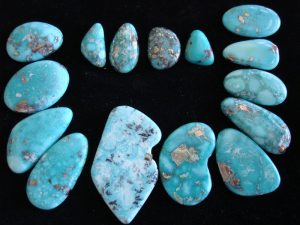
The Queen Mine in Bisbee was one of the most productive copper mines of the 20th century. It produced 8 billion pounds of copper, 2.8 million ounces of gold and 77 million pounds of silver, along with azurite and malachite. Turquoise, known as “Bisbee Blue,” is famous for its gorgeous, deep blue saturated turquoise color and was mined at the nearby Lavender Pit. There are some gorgeous turquoise specimens at the Bisbee Mining Historical Museum and the Arizona-Sonora Desert Museum in Tucson.
Morenci Turquoise with Silver Veining
The Morenci Open-Pit Copper Mine is one of the largest in the world, and along with its processing facility, is one of North America’s largest producers of copper. It is located 4.4 miles north of the town of Clifton, about 50 miles northeast of Safford in the Shannon Mountains. The mine is now owned and operated by Freeport-McMoran Copper & Gold.
The Morenci Turquoise Mine Concession (1956-1984) has not recently produced much turquoise, and old-mined material is now rare. It’s famous for its deep blue color, with beautiful silver-colored iron pyrite inclusions or spiderweb patterns. Morenci turquoise is often encountered in Navajo and Zuni Native American jewelry.
Mineral Park: Arizona’s Active Turquoise Source
The only active turquoise mine left in Arizona is the Mineral Park Mine at Turquoise Mountain, a few miles north of Kingman. The company that mines this turquoise is Colbaugh Processing, Inc., headed by Marty Colbaugh, the grandson of the original mine owner, S.A. “Chuck” Colbaugh. A variety of Kingman rough turquoise grades are offered, the majority is stabilized with resin.
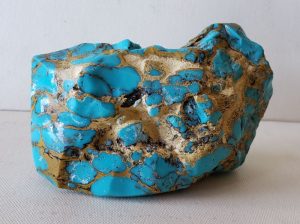
In addition, Colbaugh offers natural turquoise stabilized blocks, which start with high-grade small turquoise nuggets and do not contain any dyes. They also create compressed stabilized blocks of natural turquoise nuggets infused with bronze or zinc that offer a unique look with tendrils of bright shiny metal, simulating natural turquoise with golden matrix inclusions from the Hachita mine in New Mexico. These are popular for cabochons and knife handles.
Ancient Mines of New Mexico Turquoise
Hachita turquoise was mined at several mines, including the Azure, Cameo, Galilee and Aztec claims, about six miles west of the town of Old Hachita in Grant County, at the foothills of the Little Hatchet Mountains. The name “Hachita” means “little hatchet” in Spanish. The mines were worked by Native Americans. In the 1880’s prospectors also discovered gold, silver and copper. The pure blue turquoise color and spiderweb material is hard to find; today, mostly light greenish to dark brownish-blue material is found. The town of Cerrillos (Little Hills) is situated 15 miles south of Santa Fe, New Mexico, at an elevation of 5,688 feet. The low, arid hills around Cerrillos are formed from ancient volcanoes and have a distinctive cone shape. The Cerrillos Mining District has been known since 700 A.D., when the early Pueblo people mined and traded turquoise. By the 20th century, most of the turquoise lodes were cleaned out. Today, only a handful of private claims remain.
At the Casa Grande Trading Post & Turquoise Mining Museum, owners Todd and Patricia Brown feature rare green turquoise from their claim, “The Little Chalchihuitl.” The green color is from iron in the stone. They also mine blue turquoise from the Little Blue Bell mine, which is part of the old American Turquoise Mines. You can visit the museum and shop, or make reservations for the mine tour at www.cerrillosturquoise.com.
Whitewater’s Pastel Turquoise Color & Pyrite
Whitewater turquoise is mined in the State of Sonora, just south of the Arizona/Mexico border. The Campitos Mountains mining area includes the Campitos, Sonoran Gold, Sierra Bella and the White Water mines. The Whitewater turquoise is famous for its pastel blue color often blanketed with loads of small pyrite crystals. Beads cut from the whitewater turquoise are often treated with the Zachery enhancement method.
Persian Turquoise from Ancient Deposits
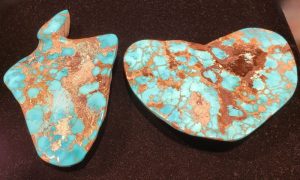
Turquoise has been mined in ancient Persia (today’s Iran) for nearly 7,000 years. The most famous deposits are from the Razavi Khorasan Province in northeastern Iran. The Nishapur turquoise is often found in veins, seams or nuggets. Color can range from solid deep robin-egg blue to blue mixed with black or brown matrix. The inclusion-free, highest-grade material with a bright sky blue color is known as Persian Blue.
Designing with Turquoise Color & Inclusions
Turquoise is fairly easy to cut and polish following classic procedures. It gets a little more challenging when inclusions of different minerals and textures are involved. Try not to work over the pyrite and quartz crystals, unless they are completely integrated in the rough. Let them be the stars of your gemstones.
Turquoise today is as popular as ever, and the jewelry pieces make a bold statement, whether it’s contemporary jewelry, Native American, boho or Western style. Choosing stones that have a little extra oomph, a silver or golden aura about them, black or golden tendrils, running veins and natural crystals all aesthetically placed, will make your jewelry even more noticeable. The turquoise color looks great both set in silver and gold, allowing for many design options.
Frequently Asked Questions About Turquoise Color Inclusions
Q1: What causes turquoise color inclusions?
A: Inclusions occur from minerals naturally present in the host rock or environment. Common inclusions include pyrite, quartz, limonite, manganese, and other trace minerals that create veins, spiderweb patterns, or crystal shapes.
Q2: Are inclusions considered flaws in turquoise?
A: Not necessarily. Inclusions can enhance a stone’s character, indicate natural origin, and even suggest the mine it came from. Completely inclusion-free turquoise is extremely rare.
Q3: Does the turquoise color change after stabilization or enhancement?
A: Stabilization can improve hardness without significantly changing color, while some treatments like the Zachery Method can enhance luster. Dyed turquoise, however, may alter the natural color.
Q4: Which turquoise mines produce the most prized color?
A: The Sleeping Beauty Mine (Arizona) is famous for pure sky-blue, inclusion-free turquoise. Other notable mines include Bisbee (Bisbee Blue), Morenci, Kingman, and Persian (Nishapur) mines.
Q5: How can I identify natural turquoise color versus treated or imitation stones?
A: Look for natural inclusions, color variations, and mineral matrix patterns. Reputable sellers should disclose treatments; lab-grown or dyed stones often appear uniform and lack natural inclusions.
Turquoise color, with its rare inclusion-free stones and unique mineral patterns, remains one of the most captivating gemstones for collectors and jewelry lovers alike. Whether you prefer the sky-blue purity of Sleeping Beauty turquoise or the intricate spiderweb patterns of Morenci and Bisbee stones, understanding turquoise inclusions helps you appreciate the natural beauty and individuality of each piece. Explore, collect, and enjoy these timeless treasures, and discover the stories hidden within every turquoise gem.
This story about turquoise color inclusions was written for Rock & Gem magazine. Click here to subscribe. Story by Helen Serras-Herman.