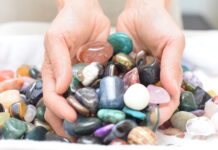

Rough gemstones and various other materials have been employed in making jewelry through the centuries. Ever since its initial creation, jewelry has played an important role in human culture, from the coronation of kings and queens to the proposal of matrimony. Gemstones have been said to have healing properties, impart wisdom, and have protective powers. It would be hard to see examples of humans not touched in some way by the influence of jewelry.
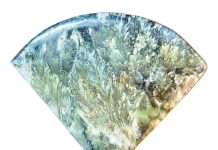
The transformation from a found piece of rough to a cabbed or faceted gem is beautiful and dramatic. Sometimes the finished piece bears little resemblance to its humble beginnings. Here are a few before and after photos of the beauty of nature’s treasures from mine to mine.
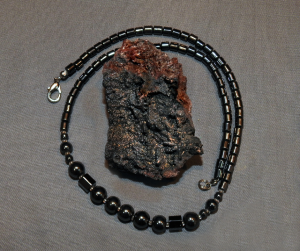 HematiteHematite is one of the most important sources of iron because of its high iron content, wide distribution, and abundance. Hematite derivс its name from the blood-red color of its powder. It has been used as a paint pigment since prehistoric times. |
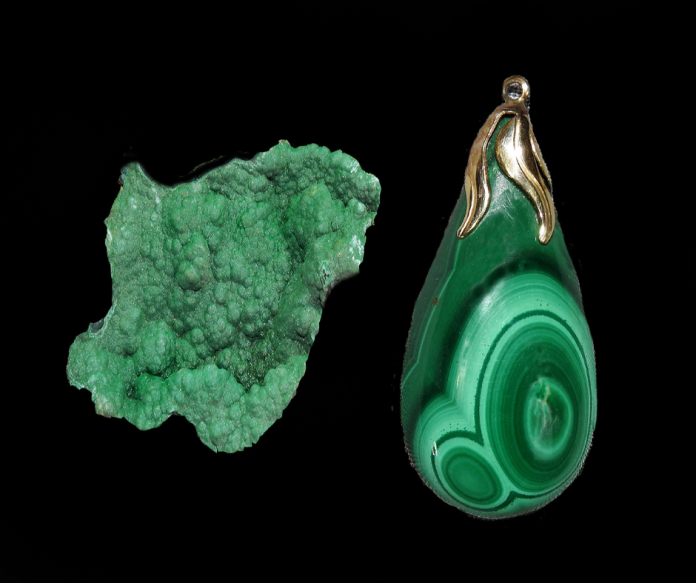
 MalachiteMalachite derives its name from a Greek word meaning “mallow green color.” Copper can be obtained from malachite using the smelting process. Malachite was used as an eye paint by the Egyptians and as a paint pigment starting in the 7th century. |
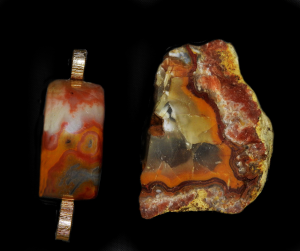 AgateMost of the Tennesee Paint Rock agate deposits are located on the west side of the Cumberland Plateau near the Tennesee-Alabama border. Agate is a common variety of chalcedony and is found with bands of different colors and transparency. Agate often gets their name from the location where they are found.
|
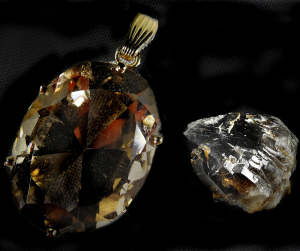 Smoky QuartzSmoky quartz is produced when clear quartz is exposed to natural radiation. It is transparent to opaque and has a brownish-gray color. With a Mohs hardness of seven, it is a good candidate for use in the jewelry trade. |
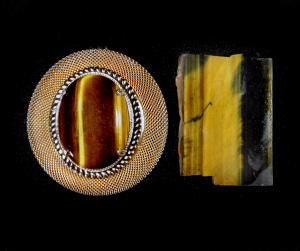 Tiger’s EyeTiger’s eye is a variety of cryptocrystalline chalcedony quartz. Its chatoyant property (cat’s eye effect ) makes it popular with collectors. Tiger’s eye is naturally golden brown. Other colors, such as red, are sold in stores and have been treated to achieve different colors. |
This story about rough gemstones to jewelry appeared in Rock & Gem magazine. Click here to subscribe. Story by Richard Gross and Pam Freeman.