
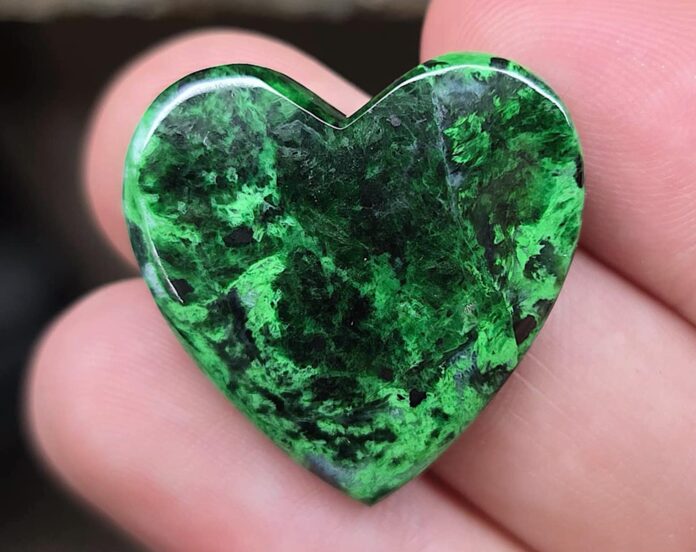
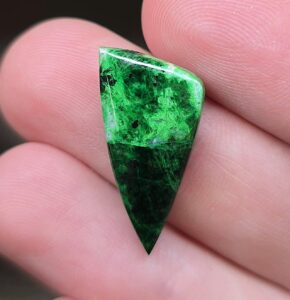
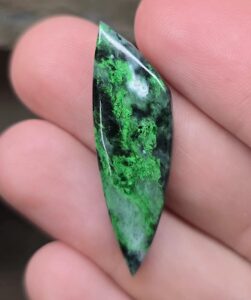
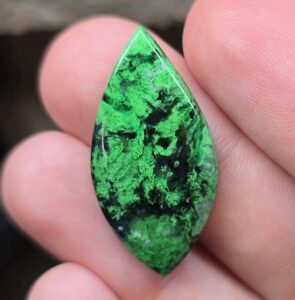
Maw Sit Sit is a rare, electrifying green stone. It is only found in the surrounding region of the village of Tawmaw, north of Myanmar. Sometimes called “Chrome Jade,” many believe this stone to be a type of jade or jadeite. Instead, it’s a metamorphic stone comprised of kosmochlor, clinochlore, albite and many other minerals. Kosmochlor, a sodium chromium pyroxene mineral, is what makes up the vibrant green coloring. Interspersed are different shades of green, swirls and dots of black and sometimes white striations. This stone is often used in jewelry and even carved pieces because of its eye-catching appearance.
History Behind Maw Sit Sit
Swiss gemologist Edward J. Gubelin found this material in the early 1960s after an invitation brought him to the Upper Burma area to take an excursion to the historical jadeite area. During his stay, Gubelin noticed a few slabs of this bright green stone. Through loose translation, he grasped that they were either stones called Maw-sit-sit or stones from Maw-sit-sit. Eventually, this interest led him to the deposit, which quickly sparked interest in this high-intensity green stone.
Finding Maw Sit Sit
Because of its scarcity, finding high-quality material will be quite pricey. I occasionally find this material at shows and online marketplaces in small pieces; anything significantly large becomes especially improbable to find for sale. The rough is generally all the same, typically in chip-sized pieces. You can’t miss that remarkable color. Grading is something I would consider when choosing from this material. Whether slabbed or rough, specimens with more prominent green and less black, are more desirable to lapidary and jewelry artists alike.
Cutting Rough Maw Sit Sit
When cutting slabs, I start with identifying any rich green sections that become my target and maximize slab yield with a thin blade. Additionally, I find that white streaks can undercut and are generally unfavorable in part.
Cabbing Maw Sit Sit
With these criteria established, finish trimming out your preforms and start on an 80-grit steel wheel. Maw Sit Sit is 6 to 7 on the Mohs scale, so it won’t generally break, but you might come across some chipped edges when using the coarse 80-grit. It is not something to be overly worried about, as it can be corrected as you continue to sand and polish the sides.
Continue onward to the 140-grit and 280grit soft resin wheels to continue doming your shape and help remove most of the deep scratches. At this stage, I tend to dry off my work to double-check if there are any remaining scratches. You can use either a towel or a can of condensed air for a quick dry. Because canned air is getting expensive, one suggestion I recommend is an electric air duster. I use one that works wonders and charges using the same cord as my phone.
Final Touches & Polishing Tips
By this point, the 280-grit should have done most of the work, removing any residual scratches. Moving toward the 600-grit, with a circular motion and medium pressure, continue to cab and check to make sure no micro scratches remain. In doing so, a gentle glow will start to appear and will be your cue before moving forward.
Continue on your preferred polishing wheels up to the 8k or 14k grit wheels to give you a nice resinous shine, or up to the 50k grit wheel for another bump in polish. I also suggest using a Dremel or Foredom rotary tool with Zam polishing compound to instantly give an added level of shine to your polish.
Want to know more about this rare stone…
Maw Sit Sit: FAQ
Q: Is Maw Sit Sit a type of jade?
A: Despite sometimes being called “Chrome Jade,” Maw Sit Sit is not true jade. It’s a rare metamorphic stone made of kosmochlor, clinochlore, albite, and other minerals.
This What to Cut column about maw sit sit appeared in Rock & Gem magazine. Click here to subscribe. Story by Ben Kaniuth.