
Mosaic art transforms stone, glass and other hard materials into detailed images built piece by piece. At a casual glance, mosaics may resemble paintings; however, they are composed of individual elements fitted together, whether tightly or with visible grouting, to form a cohesive image. These pieces can include chips of rough material, tumbled stones, precisely cut and finished stone, or combinations of all three, sometimes incorporating relief work. Ancient mosaics often used square-shaped stones and four-sided glass tesserae.
While mosaics are still created today, very few living artists carry on the tradition, as it is extremely time-consuming.
The Lizzadro Museum of Lapidary Art in Oakbrook, Illinois, near Chicago, is famous for its antique and modern collections of exquisite jade carvings and lapidary art, and most intriguing are their mosaics. Their anthology includes both Florentine and Roman mosaics, dating from the late 1700s to 1976.
Florentine Mosaic Art in Stone
Florentine pietra dura mosaics are stone pictures assembled by precisely cut stone pieces affixed to a stone backing. Hard stones (pietra dura), along with marble and scenic limestones, are thinly slabbed and ground into flat, irregularly shaped pieces, following an exact design pattern. They fit together to a close joint like a jigsaw puzzle, without grout between the stones. The finished effect depends upon the optical blending of the various pieces selected for the best gradation of colors and patterns. The work must have a flat, polished surface.
With this technique, artisans were able to obtain more realistic imagery of flowers, birds, animals, landscapes, human faces and figures. More contemporary intarsia are of a geometric nature. An extraordinary level of Florentine mosaic art form was achieved in the 19th and early 20th centuries in Florence, Italy, most inspired by earlier Italian paintings.
Florentine Mosaic Art: Portrait of Joseph Lizzadro
The first item visitors see upon entering the Lizzadro Museum is a large Florentine mosaic portrait of Joseph Lizzadro, Sr. (1893-1972), the museum’s founder. He was born in Italy and immigrated with his father to Chicago in the early 20th century. The son of a cobbler, Lizzadro’s daytime career was in electrical contracting, but he also enjoyed cutting gem materials into cabochons.
This is a memorial portrait created in 1976 by contemporary master mosaic artist Bruno Lastrucci (1943-2021) in Florence, Italy. It is made of more than 1,300 pieces of natural stone, which all fit together without any grout. Adjacent to the mosaic portrait is the original photograph from 1967, which served as the template. In the photo, Mr. Lizzadro is holding an agate bowl and looking at three jade carvings and one red coral statuette from his collection. These pieces are also on display nearby. Next to the photo is an exact tracing, numbering all 1,300 pieces of the stone mosaic.
Florentine Mosaic Art Gallery at the Lizzadro Museum
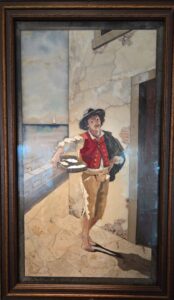
The Lizzadro Museum’s mosaic art wall gallery features a group of five Florentine mosaics. “The Return of the Fisherman” was created by Giovanni Montelatici (1871-1933) in the late 19th century and features the portrait of a young fisherman. Several versions of this subject were created by this artist. “The Chimney Sweep’s Meal,” also signed by Montelatici, is on exhibit, along with a reproduction of an original painting that inspired this mosaic. It’s a rare occurrence to have both the inspiration and the mosaic.
The “Old Folks at Table” is a large Florentine mosaic art with thousands of stone pieces, created by L. Gerbati in the early 20th century. They were slabbed to 1/16-inch thickness and hand-cut to fit tightly together. The mosaic titled “Old Folks with Wine” was created in the 1950s by G. Fiashi, a student and apprentice of Gerbati, who masterfully demonstrates his technique with the woman holding a translucent glass made of quartz.
Roman Mosaic Art and Micromosaic Techniques
Pope Gregory XIII created the Vatican Mosaic Workshop in 1576 to restore, replace, and repair aging mosaics and create new ones. In 1727, at the behest of Pope Benedict XIII, the workshop was organized as a permanent institution and re-named “Vatican Mosaic Studio.” These works are often signed with the Latin acronym RFSP (Reverenda Fabrica Sancti Petri), Reverend Fabric of Saint Peter.
The school experimented with mosaics in the 1700s, first producing large-scale mosaics with large glass square tesserae (stile grande). By the late 1700s, a new (or a 1600s rediscovered) technique emerged, known as micromosaics. These were small-scale mosaics (stile minute) with thin spun enamel threads, created by famous mosaicists Giacomo Raffaelli and Cesare Aguatti around 1780. The technique was perfected in the Vatican workshops in Rome. A palette of 28,000 colors was created by adding minerals to the spun enamel. This enabled the mosaics to become extremely detailed.
Roman micromosaics are usually created with tiny bricks of spun enamel, grouted together in rows like miniature bricks in a wall. The entire mosaic is set into a metal or stone base. Micromosaics were used for altarpieces, pictures, tabletops, snuffboxes and jewelry. They became a popular art form aimed at wealthy collectors and tourists of the European Grand Tour. They often feature pictorial representations of ancient Roman sites.
Roman Micromosaic Gallery
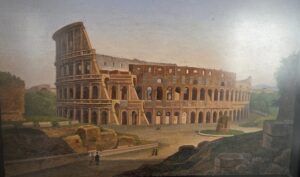
The Museum’s mosaic gallery includes five micromosaics made in Rome in the late 18th and 19th centuries. Each square inch can comprise 400 tesserae. It is an incredibly tedious work. Two of these mosaics feature Roman ruins with ancient columns and partially ruined ancient temples, a favorite subject inspired by 18th-century engravings and views of Rome. Another mosaic features the ancient Roman Colosseum.
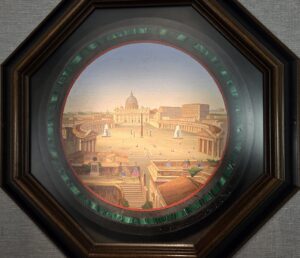
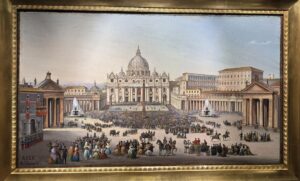
The 19th-century Roman mosaic “St. Peter’s Square” features St. Paul’s Cathedral in the back center, the red granite Vatican Egyptian Obelisk and water fountains, even people strolling, all in incredible detail. It is a round mosaic, with a beautiful malachite border, set in a marble base.
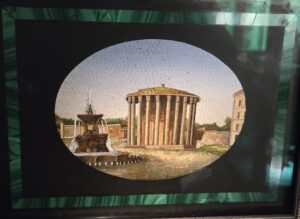
The mosaic “The Temple of Vesta” is set in black marble, also with a gorgeous malachite border. It features the Roman edifice, built and destroyed several times over the centuries. Amazingly, the museum has matched the 19th-century mosaic to a reproduction photo circa 1860, which also hangs in the gallery.
The Richard H. Driehaus Micromosaics
An additional three Roman mosaics on loan from The Richard H. Driehaus Foundation will be added to the mosaic gallery this fall. A unique version of “St. Peter’s Square” mosaic was created circa 1870 by Biaggio Barzotti from the Vatican Workshop. The micromosaic has astonishing fine details, a panoramic view of the square with people in carriages and on horseback. Even Pope Pius IX is visible standing on the balcony. Barzotti (1835-1908) was a master of the larger-scale micromosaics and was known for his superior work.
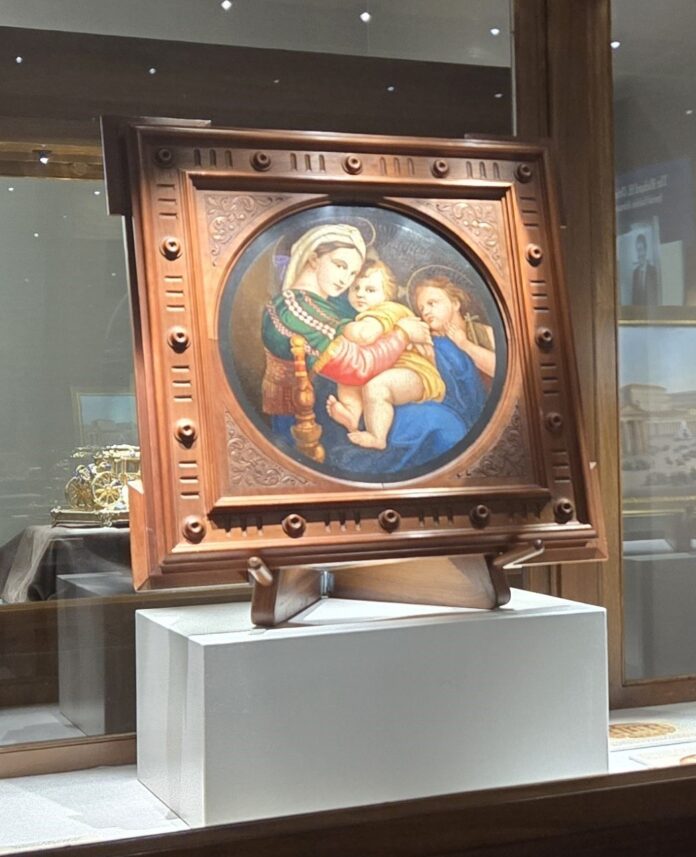
Another Driehaus collected micromosaic is “Madonna of the Chair” (Madonna della Seggiola). It is a large, round, 19th-century mosaic after the 1541 painting by the famous Renaissance painter, Raphael. The mosaicist is unknown, but it is also attributed to the Vatican Workshop in Rome. The theme depicts Mary as a young peasant woman holding Christ at her chest, sitting in a chair reserved for papal dignitaries.
Creating a Micromosaic
To create a micromosaic, first, the tesserae pieces are made from various colored glass enamel called smalti. Thousands of colors can be created. Then, the smalti are pulled into threads called filati (spun enamel) and cooled. The smalti filati is then cut into minute tesserae.
The next step is to create a metal or stone base, which is filled with a putty-like grout. The tesserae are carefully placed following the design. Finally, wax fills any gaps, and the mosaic is polished to show the best luster.
As per Anna Maria Massinelli, PhD., Decorative Art History professor in Milan, Italy, “the glass paste used to make the Roman mosaics is composed of silica (sand) mixed with melting components of soda, potash or lead oxide, plus stabilizers and metallic oxides. The tesserae must be opaque because the transparent ones are too reflective. Over 1,530 shades of each color have been produced. The glue or stucco may be prepared up to a year in advance.”
The manner of creating these mosaics is labor-intensive, and the art production is extremely limited today, but the Vatican Workshop is still in existence, and a few artists continue the tradition, repairing old pieces and creating new artwork.
 History of the Lizzadro Museum
While on the hunt for rough jade for his cabochons, Joseph Lizzadro came across a beautiful carved Chinese jade vase. Soon after found himself enamored with jade carvings from China and started his massive collection. The museum opened in Elmhurst, Illinois, in 1962, and permanently displays over 200 jade (both jadeite and nephrite) carvings and other hard stone carvings from around the world.
Visit the Lizzadro Museum of Lapidary Art
In 2019, the museum moved to a new 15,000 square foot facility in Oak Brook, Illinois, 18 miles west of downtown Chicago. Its unique exhibits are rarely seen anywhere else in this country. In addition to their jades, dioramas with carved gemstone animal figurines, gem and mineral displays, cameo bowls and brooches, and contemporary lapidary art fill the galleries.
A visit to this museum may open new lapidary horizons to contemporary gem artists. The museum’s mission shares the beauty of gemstones, promotes the study of rocks and minerals, and hosts guest speakers for lectures. Visit them at www.lizzadromuseum.org.
Frequently Asked Questions About Italian Mosaic Art
What is Italian mosaic art?
Italian mosaic art is a decorative art form that creates images from small pieces of stone, glass or enamel called tesserae. Developed and refined over centuries in Italy, it includes Florentine pietra dura mosaics made from precisely cut stone and Roman mosaics and micromosaics created with glass and enamel.
What is the difference between Florentine and Roman mosaic art?
Florentine mosaic art, also known as pietra dura, uses thinly cut pieces of natural stone fitted tightly together without grout and polished to a flat surface. Roman mosaic art traditionally uses glass or enamel tesserae set into a grout or adhesive, with micromosaics employing extremely fine tesserae to achieve remarkable detail.
What is a micromosaic?
A micromosaic is a small-scale mosaic created with minute tesserae made from spun enamel threads called filati. Developed in Rome in the late 18th century, micromosaics can contain hundreds of tesserae per square inch and were often used for tabletops, jewelry, and collectible artworks.
Why is Italian mosaic art so labor-intensive?
Italian mosaic art requires painstaking handwork at every stage, from cutting or spinning the tesserae to placing each piece individually according to a detailed design. Complex works, especially micromosaics, may take months or even years to complete, contributing to the rarity of contemporary examples.
Where can historic Italian mosaic art be seen today?
Historic Italian mosaic art can be found in churches, museums and private collections throughout Italy and beyond. In the United States, the Lizzadro Museum of Lapidary Art houses an exceptional collection of Florentine mosaics and Roman micromosaics dating from the 18th through 20th centuries.
This story about Italian mosaic art appeared in Rock & Gem magazine. Click here to subscribe. Story and photos by Helen Serras-Herman.