
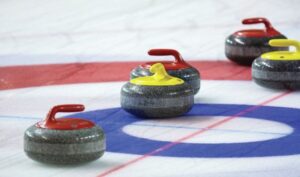
Curling stones will be front and center when the 2026 Winter Olympics open in Italy in February. Nearly 3,000 athletes from 91 countries will be vying for medals. Most will compete in the marquee sports of skiing, skating, snowboarding and bobsledding. There will also be 120 athletes from 13 countries competing in the sport of curling. This consists of sliding 44-pound stones across 146 feet of ice toward 12-foot-diameter circles.
Curling was once a rather obscure pastime practiced only in a few cold-climate countries. But since its introduction as an Olympic medal sport in 1998, public interest in curling has grown steadily. Attention is focused on the game’s unusual skill-set and teamwork requirements, along with the curling stones themselves.
Adobe Stock/ Ansis
From the Frozen Lochs of Scotland
The oldest known curling stone is inscribed with the date 1511. The earliest documented contest was held in 1541 between Scottish monks on a frozen loch. In 1565, Flemish artist Pieter Bruegel depicted curling scenes. This indicates that the sport had by then spread to the Low Countries.
The word “curling” itself dates to 1620. It refers to the slightly curved trajectory caused by the rotation of the sliding stone. While the first Scottish curling clubs appeared in the 1700s, formal rules were not established until 1838.
By 1850, Scottish emigrants had taken the sport to Canada, the United States, Switzerland and Sweden. Scotland hosted the sport’s inaugural world championship in 1959. Today, it continues to gain popularity across Europe and North America. It is spreading to South America, Asia and Australia.
Getty Images/Lillian Suwanrumpha
The Evolution of Curling Stones
The first stones used in this sport were flat-bottomed, naturally rounded, granite fieldstones that were crudely fitted with iron handles to improve control when launching them across ice.
By the time curling stones were first commercially manufactured in Scotland in 1851, they had become uniformly circular with flat, smooth bottoms and rounded tops. Most weighed about 40 pounds, the weight needed to provide the momentum to carry the stones over the ice.
Curling Stones Today
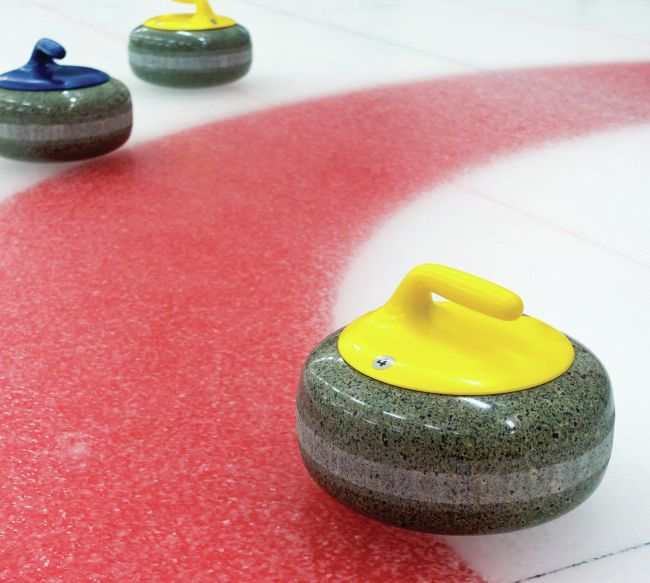
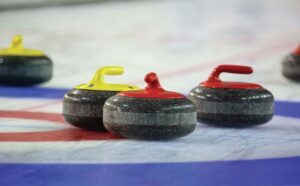
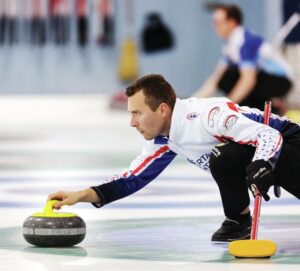
Today, an Olympic curling stone has a maximum circumference of 36 inches and a minimum height of 4.5 inches and weighs between 38 and 44 pounds. The sides have a gentle, convex bulge. Brightly colored handles, which identify each team’s stones, are attached to a steel bolt running vertically through the center, which enables the stone to be firmly gripped and precisely rotated upon launching.
Olympic curling stones are made of two types of granite, each with different properties and purposes. Because curling strategy involves striking and displacing stones of the opposing team, the “striking bands”—the convex sides where contact occurs—must absorb high levels of impact energy. The bulk of the stone, including its striking band, consists of exceptionally durable, low-quartz Common Green granite, the only granite capable of enduring repetitive collision-impact stresses without chipping
The base of a curling stone is concave with only a half-inch-wide outer ring, called the “running band,” actually contacting the ice. Because of repetitive freezing and thawing, running bands are particularly susceptible to physical deterioration. For this reason, the base of the stone, including its running band, is made of impervious Blue Hone granite inset into the stone’s main body. Exceptionally dense and compact, Blue Hone granite does not absorb water, and thus the running band does not deteriorate.
Getty Images/Andrew Francis Wallace
Ailsa Craig: The Island Behind Curling Stones
Both Common Green and Blue Hone granite come from a single source—Ailsa Craig, a small island off southwest Scotland’s Ayrshire Coast. Although less than a square mile in area, the island has a summit height of 1,120 feet. Geologically, Ailsa Craig is the remnant of a hard igneous intrusion that resisted the weathering and erosion that reduced surrounding sedimentary formations.
Since the early 1500s, Ailsa Craig has been used by smugglers, pirates, fishermen and goatherders. It was also used by persecuted Catholics seeking refuge during the Scottish Reformation. A lighthouse was built and a foghorn installed there in the mid-1800s, and a small quarry was opened to extract the island’s durable granite. Today, the privately owned, uninhabited island serves as a wildlife preserve for huge flocks of seabirds.
Adobe Stock/Ansis
Kays of Scotland
The small firm, Kays of Scotland, is the sole producer of Olympic curling stones. Holding exclusive collecting rights to Ailsa Craig granite, Kays gathers a boatload of Common Green and Blue Hone boulders roughly every decade—enough to manufacture several thousand curling stones.
Using diamond-studded cutting wires, Kays slices Common Green granite boulders into five-inch-thick slabs. Rotary diamond drills then “punch” out circular blanks that are ground into rough curling-stone shape. After the specially fabricated Blue Hone granite base is fitted into the bottom of the Common Green granite body, the entire unit is ground to its final shape, then polished with progressive stages of diamond grit. On average, Kays produces 40 finished stones per week. Each new Olympic-grade curling stone costs nearly $1,000.
Frequently Asked Questions About Curling Stones
What are curling stones made of?
Olympic curling stones are made from two rare types of granite—Common Green and Blue Hone—quarried on Ailsa Craig, a small island off the coast of Scotland. Each granite type serves a specific purpose, balancing durability with smooth performance on ice.
Why do curling stones weigh so much?
Curling stones weigh between 38 and 44 pounds to provide enough momentum to travel the length of the ice while remaining stable and controllable. The weight also allows stones to strike and displace others during play.
Why do curlers sweep the ice?
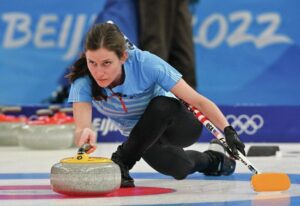
Sweeping slightly warms and smooths the ice surface in front of a moving stone, reducing friction. This helps curlers control both the stone’s speed and its curved path.
Why is granite used for curling stones?
Granite is exceptionally durable and resists chipping during repeated impacts. The specific granites used in curling stones can withstand freezing, thawing, and high-energy collisions without deteriorating.
Are all Olympic curling stones made in Scotland?
Yes. Olympic-grade curling stones are produced exclusively by Kays of Scotland using granite from Ailsa Craig. The island is the only known source of granite that meets Olympic standards.
And what is the purpose, during a match, of that frantic sweeping in the path of the moving stone? It conditions the ice to provide a subtle degree of control over the stone’s trajectory and travel distance, which can be critical in competition. It’s all part of the story of how two rare types of granite moved from a remote Scottish island to the bright lights of Olympic ice.
This story appeared in Rock & Gem magazine. Click here to subscribe. Story by Steve Voynick.