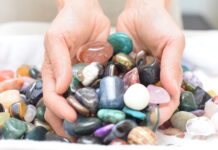


Chakra stones are among the most commonly sold and requested crystals in the rock and gem trade, whether buyers approach them as tools for meditation, personal symbolism, or simple curiosity. The concept of chakras comes from ancient traditions that organized stones by color, placement, and perceived qualities, creating a system that still influences how crystals are grouped, marketed, and collected today.
For collectors and dealers alike, understanding chakras provides useful context for why certain minerals—such as hematite, quartz, tiger’s eye, and amethyst—are consistently associated with specific categories. Even without adopting a metaphysical viewpoint, chakras offer a long-standing framework for understanding how stones have been selected, used, and valued across cultures. When people talk about “energy,” they are often describing information, symbolism, and experience—and that’s where stones naturally come into play.
“Each stone has a specific history and purpose,” explained Yevette Binden, creator and teacher of Soul Discovery in Great Falls, Montana. “Understanding which stones have been associated with each chakra gives collectors and practitioners a practical way to organize and use them.”
Chakra stones have long been grouped according to color, location in the body, and traditional use, creating a system that guides both collectors and sellers. While the idea of “energy centers” has spiritual roots, the framework also serves as a practical map for selecting and categorizing stones, understanding why certain minerals are paired together, and appreciating their historical significance. These stones have consistent patterns of use across cultures, which makes them familiar touchpoints for anyone working with or collecting crystals.
The Mind–Body Connection in Stone Traditions
While chakras are often discussed in spiritual contexts, they also provide a practical framework for understanding why certain stones have been grouped and used together for centuries. Collectors and dealers can observe patterns: specific minerals are repeatedly associated with particular chakras, colors, or symbolic roles, creating a consistent system that guides both display and sale.
This perspective doesn’t require adopting metaphysical beliefs. Instead, it emphasizes the relationship between stones and their traditional uses, as well as how cultural practices influence the market for minerals. For example, stones historically associated with the heart chakra are typically green or pink—an easy visual cue for collectors and sellers alike.
“Understanding these patterns helps collectors and practitioners make informed choices about which stones to acquire or work with,” said Yevette Binden. “It’s not about belief; it’s about knowing the history and the context for each stone.”
By recognizing these connections, collectors gain insight into why some stones are consistently popular, how to categorize a growing collection, and how to appreciate the historical significance behind each mineral. In short, chakra traditions offer a practical roadmap for properly storing and organizing, displaying, and using stones—whether for personal interest, collection or commerce.
Organizing and Using Stones for Chakras
Collectors and enthusiasts often find it helpful to work with stones in a deliberate way, whether for display, study, or personal projects. Just as museums group minerals by type, color, or origin, chakra stones are traditionally organized according to the system of seven main energy centers. This approach offers a practical roadmap for selecting, arranging and understanding crystals.
“Sometimes it’s not about metaphysical energy—it’s about seeing patterns and making connections,” explained Yevette Binden, creator and teacher of Soul Discovery in Great Falls, Montana. “When clients choose stones for specific chakras, they’re learning how to identify and work with the characteristics of each mineral.”
Organizing stones by chakra can also enhance a collection visually. Each chakra is associated with a color, so arranging stones along the traditional sequence—root through crown—creates a spectrum that is both educational and aesthetically appealing. Collectors can compare variations, note differences in color, texture, or luster, and appreciate how the same mineral can appear in multiple contexts.
Beyond display, this system provides guidance for selecting stones for personal use or projects, whether that’s teaching, jewelry making, or simply exploring a collection. By treating chakras as a historical and organizational framework, collectors and sellers gain a practical method for understanding the long-standing patterns that have guided stone selection for centuries.
The Seven Chakras & Their Stones
The seven main chakras have long served as a way to organize and classify stones by color, placement, and traditional associations. For collectors, this system offers a practical framework: it helps explain why certain minerals appear together, how to group stones for display, and how to recognize patterns that have been used for centuries. Each chakra has a set of stones most commonly linked to it—whether for their color, hardness, texture, or historical significance—making them easy to identify and study. Understanding these associations provides insight into both the cultural history of crystal use and the practical choices collectors and sellers make when building a collection.
Root Chakra Stones
The root chakra, located at the base of the spine, is traditionally associated with the color red and with stones that are grounding, dense, and visually striking. For collectors, this chakra highlights minerals that are rich in color and texture, often forming the foundation of a collection both visually and structurally.
Stones linked to the root chakra, such as hematite, tiger’s eye, and red jade, have been grouped together for centuries due to their deep tones and historical associations with stability and endurance. This makes them popular for display as a cohesive set or as part of a spectrum of chakra stones.
“Collectors often notice that these stones are easier to identify and categorize because of their consistent coloration and structure,” said Yevette Binden, creator and teacher of Soul Discovery in Great Falls, Montana. “Working with root chakra stones can teach you a lot about texture, weight, and mineral characteristics.”
Stones to Use
-
Tiger’s Eye – Known for its layered, chatoyant bands and durability, tiger’s eye is visually striking and easy to handle in collections.
-
Red Jade – A dense, smooth stone whose rich red color makes it a standout in any display.
-
Hematite – Metallic and silvery, hematite adds contrast and variety while illustrating iron-rich mineral properties.
Sacral Chakra Stones
The sacral chakra, located just below the navel, is traditionally linked with orange-colored stones. For collectors, this chakra highlights minerals that are vibrant, translucent, or luminous, providing both visual interest and a study in variations of color and texture.
Stones associated with the sacral chakra—such as carnelian and moonstone—have long been grouped together for their warm tones and historical significance in jewelry and ornamentation. Collectors often appreciate how these stones display natural color zoning and internal structure, making them ideal for hands-on study and display.
Stones to Use
-
Carnelian – A smooth, translucent orange stone prized for its range of warm hues and historical use in carvings and jewelry.
-
Moonstone – Recognized for its soft luster and adularescence, moonstone adds depth and visual complexity to a collection.
Solar Plexus Chakra Stones
The solar plexus chakra, situated near the upper abdomen, is traditionally associated with bright yellow stones. For collectors, this chakra is a showcase for vibrant, eye-catching minerals that vary in transparency, color saturation, and crystal structure.
Stones like citrine and pyrite have been paired with this chakra for centuries due to their vivid tones and historical value. Citrine’s clarity and pyrite’s metallic luster make them both excellent specimens for study, display, and comparative analysis.
Stones to Use
-
Citrine – A yellow quartz with excellent clarity and color range, prized for both aesthetics and collectibility.
-
Pyrite – Metallic and reflective, pyrite demonstrates natural crystal formation and iron-rich mineral properties.
Heart Chakra Stones
The heart chakra, located in the center of the chest, is traditionally associated with green and pink stones. These colors provide collectors with opportunities to study subtle variations in hue, transparency, and inclusions within minerals.
Stones such as rose quartz, malachite, and green jade have long been grouped with this chakra due to their historical use in carvings, jewelry, and cultural artifacts. Their consistent color patterns make them ideal for display in spectrum arrangements or educational collections.
Stones to Use
-
Rose Quartz – Soft pink tones with translucency, frequently collected for its aesthetic consistency.
-
Malachite – Deep green with banded patterns, offering texture and visual complexity.
-
Green Jade – Smooth and dense, known for its historical significance and collectibility.
Throat Chakra Stones
The throat chakra, located at the base of the neck, is traditionally associated with blue stones. These minerals are valued for their clarity, tonal depth, and historical associations with communication and symbolism.
Collectors often note how aquamarine, sodalite, and lapis lazuli display color consistency, striations, and polishability, making them excellent specimens for both study and display.
Stones to Use
-
Aquamarine – Pale blue to blue-green, transparent and prized for clarity and mineral quality.
-
Sodalite – Deep blue with white veining, valued for visual contrast and textural interest.
-
Lapis Lazuli – Rich blue stone historically used in pigment, jewelry, and carvings.
Third Eye Chakra Stones
The third eye chakra, located between the eyebrows, is traditionally associated with indigo and violet stones. These minerals offer collectors an opportunity to study subtle color shifts, translucency, and iridescent effects.
Stones such as labradorite, amethyst, and iolite have long been grouped here for their visual complexity and cultural history. Collectors often appreciate how labradorite’s play of color or iolite’s pleochroism demonstrates natural optical properties.
Stones to Use
-
Labradorite – Exhibits labradorescence, with shifting blues and greens that make it visually dynamic.
-
Amethyst – Purple quartz prized for clarity, color range, and historical use in artifacts.
-
Iolite – Known for pleochroism, allowing different hues to appear from different angles.
Crown Chakra Stones
The crown chakra, located at the top of the head, is traditionally associated with violet or white stones. These minerals are often collected for their clarity, translucency, and high visual appeal.
Clear quartz and selenite are commonly associated with this chakra, valued for their historical significance and versatility in collections. Their structural qualities and optical clarity make them excellent specimens for display, study, and comparison with other stones.
Stones to Use
-
Clear Quartz – Highly transparent and structurally well-formed, a classic collectible mineral.
-
Selenite – Fibrous, soft, and translucent, historically used for decorative purposes and educational study.
Tips for Organizing and Using Chakra Stones
When working with chakra stones, it helps to start with the lower chakras—root, sacral, and solar plexus—because their stones tend to be denser, more visually striking, and easier to handle. This approach provides a practical foundation for display and study before moving on to stones associated with the higher chakras.
Finding stones that resonate with a collection can be as simple as color, size, or texture. Arranging stones in sequence—root through crown—creates a visually appealing spectrum and highlights the differences between minerals within the same chakra group. This method also makes it easier to compare characteristics like luster, clarity, and crystal formation across types.
Collectors can also use the system as a guide for building or expanding a collection, whether for display, study, or teaching purposes. Selecting stones according to traditional chakra associations provides a framework for organization, while still leaving room to explore variations, rare specimens, and regional differences.
“Working with chakra stones is about observation and organization,” said Yevette Binden, creator and teacher of Soul Discovery in Great Falls, Montana. “It helps collectors notice patterns in color, structure, and quality—and understand why certain stones have been grouped together for centuries.”
By treating chakras as a practical organizing system, collectors and dealers gain a structured way to display, study, and appreciate stones, making the process both educational and visually engaging.
FAQ: Chakra Stones
Q: What are chakra stones?
A: Chakra stones are minerals traditionally grouped by color and historical association with the seven main chakras. Collectors and dealers use this system for organizing, displaying, and studying crystals.
Q: Do I need to believe in energy or metaphysics to use chakra stones?
A: No. Understanding chakra stones is valuable for collectors and dealers as a framework for categorizing stones, studying mineral properties, and arranging visually appealing displays.
Q: Which stones are most commonly associated with each chakra?
A: Examples include hematite, tiger’s eye, and red jade for the root chakra; carnelian and moonstone for the sacral chakra; citrine and pyrite for the solar plexus; rose quartz, malachite, and green jade for the heart; aquamarine, sodalite, and lapis lazuli for the throat; labradorite, amethyst, and iolite for the third eye; and clear quartz and selenite for the crown chakra.
Q: How can chakra stones improve a collection?
A: Using the chakra system helps collectors organize stones by color, structure, and historical use. It also provides a framework for display, comparison, and educational purposes.
Q: Can chakra stones be sold or traded?
A: Yes. Dealers often group chakra stones together in sets or displays, as their traditional color associations and historical significance make them desirable to collectors and buyers.
Chakra stones offer more than just visual appeal—they provide a window into centuries of cultural tradition and mineral use. By understanding how these stones have been grouped by color, structure, and historical association, collectors and dealers can organize, display, and expand their collections with purpose. Whether studying variations in mineral formation, comparing textures, or arranging stones in sequence for display, chakra stones combine beauty, history, and practicality, making them a rewarding addition to any rock and gem collection.
This story about understanding chakra stones previously appeared in Rock & Gem magazine. Click here to subscribe. Story by Amy Grisak.