
A volcano in Italy is not just a mountain; it’s a laboratory of magma chemistry, tectonic twists, and eruptive surprises. Italy is home to some of Europe’s most famous and active volcanoes, each with its own fiery personality. From the historic eruption of Mount Vesuvius that buried Pompeii, to the near-constant rumblings of Mount Etna and Stromboli. For geologists, rock collectors, and curious travelers alike, exploring Vesuvius, Etna, and Stromboli reveals a diversity of volcanic rocks and minerals rarely seen anywhere else.
Mount Vesuvius: A Historic Volcano in Italy
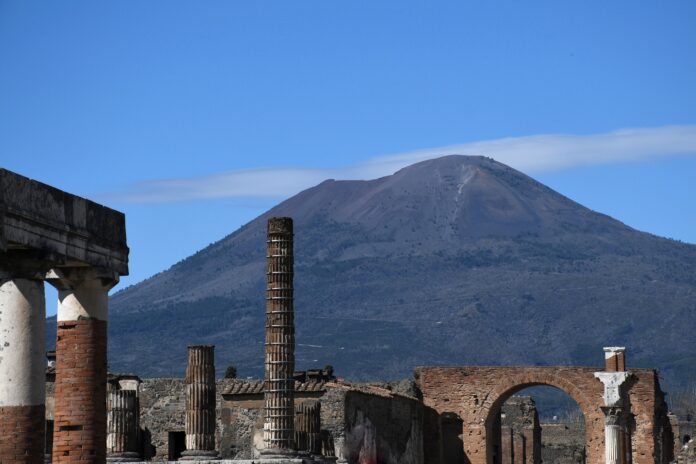
Mount Vesuvius, towering over Naples, is infamous for its eruption in A.D. 79 that buried Pompeii and Herculaneum beneath pyroclastic deposits. This classic stratovolcano, also called a composite volcano, forms at subduction zones—where a dense oceanic plate slides beneath a lighter continental plate. In southern Italy, the African Plate subducts beneath the Eurasian Plate, releasing water into the overlying mantle. This lowers the melting point of mantle rocks, producing magma that rises toward the surface. Because this magma contains dissolved gases and water vapor, eruptions are typically explosive.
Vesuvius’ Volcanic Rocks
In general, Vesuvius erupts a myriad of rocks from across the igneous chemical spectrum. This includes felsic (light color-rich in silica, aluminum, sodium, and potassium), mafic (dark color-silica poor-rich in iron and magnesium), and those in-between (intermediate composition).
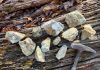
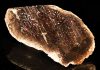
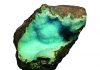
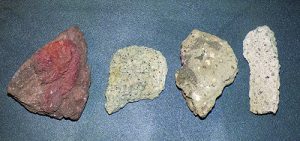
Composite volcanoes that are land-bound are known to produce eruptive rocks that are typically intermediate to felsic. The pumice is a lightweight felsic rock littered with gas-voids. The yellow shades found here are a result of weathering. The tephrite is a type of intermediate rock composed of small and coarse crystals. The latter, precipitating from underground magma, whereas the former is cooled erupted lava that carried the larger pre-formed crystals to the surface. This is termed a porphyritic texture. Intermediate porphyry rocks are all but typical with stratovolcanoes, but these tephrites are a little different than their far more common cousins, termed andesites. Tephrites differ in that they have no quartz, but a nominal presence of feldspathoid minerals, such as nepheline (Na, K)AlSiO4 and leucite (KAlSiO3).
Hiking the Crater
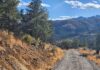
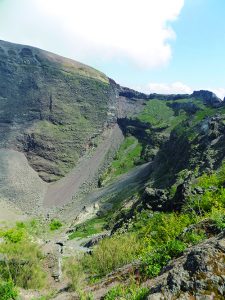
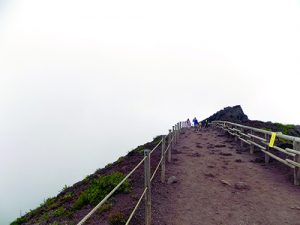
Visitors ascending Vesuvius encounter a vivid landscape of volcanic rocks. Blue-green tephrites and brick-red scoria dominate the trail, providing a striking visual record of past eruptions. During a personal visit, a short rolling-in of a wall of fog obscured our panoramic view of Naples in the distance and made us feel like we had set foot on another planet.
Mount Etna: Europe’s Tallest Volcano in Italy
Mount Etna, on the eastern coast of Sicily, is the tallest active volcano in Europe and one of the most geologically complex. Unlike Vesuvius, Etna does not fit neatly into classic subduction-zone models. Its frequent eruptions and diverse lava types reflect a combination of fault-controlled pathways, mantle upwelling, and a tectonic region influenced by both subduction and crustal rifting.
Visitors to Etna can witness a wide variety of volcanic phenomena, from black basalt flows to pahoehoe lava textures—rope-like surfaces named for their twisted, flowing appearance, similar to lava formations in Hawaii. These formations record the volcano’s eruptive history and the viscosity of its lavas, which are higher than typical basaltic flows.
Lava Tubes and Volcanic Formations
Etna features lava tubes and smaller eruptive craters along its southern slope. Lava tubes form when the surface of a lava flow cools while molten material continues to flow beneath, creating hollow conduits. Unlike Hawaii’s extensive lava tube systems, Etna’s tubes are shorter due to the higher viscosity of its lava. For us, the tubes of Etna proved to be cozy and provided temporary shelter from the near-freezing rain outside. Along the tube walls, we found small, albeit very interesting flora growing as well as large pothole-like features. The latter is caused by anomalously large gas bubbles escaping the cooling lava.
Visitors often encounter deposits of vesicular basalt, scoria, and welded ash tuffs, along with rocks bearing minor mineralizations such as chalcedony or common opal. These materials provide a vivid record of past eruptions and varying eruption styles.
Silvestri Crater and Recent Flows
Among Etna’s numerous small eruptive centers, the Silvestri Crater stands out. Although now extinct (last erupted in 1892), it exhibits abundant red scoria and deposits of welded ash tuff. These materials record the explosive activity of Etna’s past eruptions. Remnants of more recent lava flows, including those from the 1980s and early 2000s, illustrate how quickly the volcano reshapes the landscape—even encroaching on structures near the slopes.
The variety of rocks found on Etna, from basalt to ash tuff and alkaline rhyolites, reflects the complex magma sources beneath the volcano. Faults in the region allow magma to ascend rapidly, explaining both frequent eruptions and the wide compositional range of the erupted materials.
Etna’s Geological Complexity
Etna’s unusual magma chemistry sets it apart from many stratovolcanoes. In addition to standard basaltic lavas, eruptions produce sodium-alkaline rocks, peralkaline rhyolites, and rare potassium-rich compositions. This diversity likely results from hybrid sources, including mantle upwelling in areas where the African Plate has torn slightly during subduction, and assimilation of crustal material as magma rises.
Even for experienced volcanologists, Etna offers a puzzle: its frequent activity, diverse rock types, and complex tectonic setting continue to attract study and fascination.
Stromboli: The Island of Everlasting Fire in Italy
Stromboli, part of the Aeolian Island Arc north of Sicily, is renowned for its almost continuous volcanic activity. The island’s frequent eruptions, roughly every 1–2 hours, give it the nickname “the Lighthouse of the Mediterranean.” Stromboli’s eruptions are classic examples of Strombolian activity, characterized by intermittent bursts of incandescent lava, volcanic gas, and ash.
Panarea: A Volcanic Playground
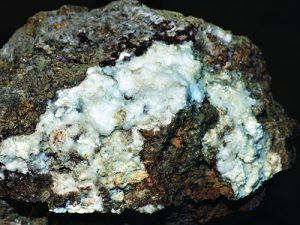
Nearby Panarea, an extinct volcano, offers a glimpse of Aeolian geology without the need for strenuous hiking. The island’s shorelines contain welded ash tuff, porphyritic andesite with feldspar and hornblende phenocrysts, and vesicular scoria. Some studies also indicate the presence of massive sulfide mineralization, including galena, sphalerite, and pyrite, in shallow marine sediments just off the island.
For collectors and geologists, Panarea provides easy access to a variety of volcanic rocks, showcasing the Aeolian arc’s mineralogical diversity.
Black Sand Beaches and Volcanic Boulders
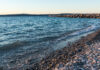
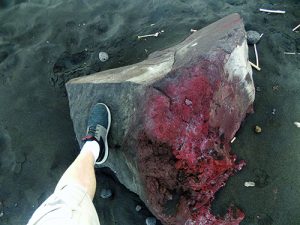
Stromboli’s black sand beaches are composed of weathered pyroxene, amphibole, and magnetite, dotted with large volcanic boulders formed from scoria, vesicular basalt, and pyroclastic tuff. These formations record the volcano’s eruptive history and ongoing activity, and are accessible to visitors along the shoreline.
Even brief walks along these beaches reveal the island’s raw geological power: the textures, mineralization, and layering of volcanic rocks provide a vivid picture of frequent eruptions.
Fire Street: Observing Active Eruptions
The most striking feature of Stromboli is its main eruptive slope, the Sciara del Fuoco (Fire Street). From a safe distance, visitors can witness lava flowing down defined channels and periodic explosions of ash and molten rock. The slope’s sharply defined contours are shaped by repeated eruptive events, illustrating how continuous activity builds and modifies the volcano’s landscape over time.
Weather conditions can obscure visibility, but even brief glimpses of lava and gas plumes provide insight into the volcano’s near-constant activity.
Stromboli’s Geological Significance
Stromboli’s eruptions produce a range of volcanic rocks, including basalt, scoria, andesite, dacite, rhyolite, and potassium-rich alkaline rocks such as trachyte, latite, and shoshonite. The island exemplifies how a volcano in Italy can generate diverse rock types, even in a relatively compact area. Frequent eruptions, combined with offshore mineralization and black sand beaches, make Stromboli a natural laboratory for studying both volcanic processes and their effects on surrounding ecosystems.
Similar, But Different: Comparing Volcanoes in Italy
While all three of Italy’s famous volcanoes—Vesuvius, Etna, and Stromboli—share the general characteristics of stratovolcanoes, each exhibits unique geological traits. Stratovolcanoes are typically formed where an oceanic plate subducts beneath a continental plate, generating magma as water from the descending plate lowers the melting point of the overlying mantle. This magma may erupt explosively, producing a range of extrusive igneous rocks, including andesites, dacites, rhyolites, and minor basalts.
Mount Vesuvius: A Slightly Unusual Subduction Volcano
Vesuvius is somewhat atypical compared with standard subduction-zone volcanoes. The African Plate’s northward movement beneath the European Plate involves a process called delamination, where the subducting plate’s leading edge detaches. This creates space for deeper mantle material to rise, introducing chemical variations into the magma. Additional crustal contamination as magma ascends further contributes to the variety of rocks formed, including tephrite, a basaltic rock containing feldspathoid minerals like nepheline and leucite. These “feldspar wannabes” form under silica-undersaturated conditions, giving Vesuvius a unique geochemical signature among Italy’s volcanoes.
Mount Etna: Complexity in Crustal Faulting and Magma Sources
Etna defies simple classification. While it sits near a subduction zone, its position is slightly too far from the African Plate boundary to fit classic models. The surrounding area contains numerous accreted terranes and crisscrossing faults caused by alternating compression and extension. These fault networks allow magma to ascend more easily, contributing to Etna’s frequent eruptions.
Etna’s lava and ash are correspondingly diverse, including basalt, welded ash tuff, sodium-alkaline rocks like phonolite, and peralkaline rhyolite. Some studies suggest the volcano is influenced by a mantle upwelling where a tear in the subducting African Plate allows anomalously hot material to rise, creating magma in an unusual location. Despite decades of research, Etna’s precise magma sources remain a topic of ongoing study.
Stromboli: A Concentration of Potassium-Rich Magmas
Stromboli, though smaller, is no less geologically complex. Its eruptions produce basalt, scoria, andesite, dacite, rhyolite, and a variety of potassic-alkaline rocks such as trachyte, latite, shoshonite, and trachybasalts. Globally, these potassium-rich rocks are rare, yet they are widespread along the Aeolian Arc. The origin of these unusual magmas is still debated, making Stromboli a key location for studying diverse volcanic processes.
Key Takeaways: One Region, Many Flavors
Despite their differences, visiting one volcano in Italy or all three demonstrates the incredible diversity of volcanic processes in a single region. From Vesuvius’ slightly unusual subduction chemistry, to Etna’s fault-controlled eruptions, to Stromboli’s potassium-rich lavas, the variety of rock types and eruption styles provides a vivid lesson in the complexity of volcanoes in Italy. This diversity is a large part of what continues to draw geologists, rock collectors, and curious visitors to these fiery landscapes.
This volcano in Italy article was written for Rock & Gem magazine. Click here to subscribe. Story by Mark Leatherman