Writers’ Guidelines

Welcome to Rock & Gem, the leading magazine for rockhounding and lapidary hobbyists since 1971. Our goal is to provide informative and entertaining articles and to draw new people into the hobby. Our readers are also our greatest editorial contributors. This document contains all the information you need to succeed in having an article published in Rock & Gem.

WHAT WE BUY

Rock & Gem is particularly interested in field-trip and step-by-step lapidary project articles. We also accept articles pertaining to specimen collecting, gold prospecting, club activities, basic and advanced lapidary skills, lapidary artist profiles, and other hobby-related subjects. Articles that educate beginning rock collectors or lapidaries and promote active participation in the hobby are especially welcome.

Feature length: 2,000 to 3,000 words
Articles under 2,000 words may be used at the editor’s discretion, but will not receive full payment (see Contributor Agreement).

Field-trip articles should give specific, easy-to-follow directions to the site(s) discussed. Research sites carefully to make sure they are not under claim or closed to collecting. The photos should show the site(s) and types of specimens collected. Include a clear, specific, hand- or computer-drawn map of the field-trip area(s).

Freelance authors accept responsibility for the accuracy of their facts. Please confirm any statistical or factual information with a reliable source before submitting an article.

How-to length: 800 to 1,000 words
How-to articles should give clear, step-by-step instructions for completing a lapidary project (see specific how-to guidelines on page 3).

QUERIES

You may contact the editor to ask whether your topic is suitable for Rock & Gem. After that, we want to see the completed story with photos.

ARTICLE SUBMISSION

All submissions must be made via mail; Rock & Gem does not accept e-mailed submissions. Only send articles that have not been previously sold or published (club newsletters don’t count).

A complete submission package will include:

  • A cover letter with your mailing address, phone number, and e-mail address;
  • a printed manuscript and caption list;
  • electronic copies of the manuscript and caption list on a CD or memory stick;
  • color photographic prints or digital photos on a CD or memory stick (no laser prints).

Incomplete submission packages will be automatically rejected.

  • All submissions are taken on speculation.
  • Articles selected for publication are subject to editing.

PHOTOGRAPHS

Provide eight to 15 clear photographs to illustrate your story. We cannot use blurry photographs and we do not accept articles without photographs.

Rock & Gem accepts:

  • color photographic prints
  • digital photos

Digital photos must be:

  • .tif or .jpg files;
  • high-resolution (300 dpi at 4” by 5” minimum);
  • submitted on CD or memory stick* (please include a proof sheet, if possible).

*CDs and memory sticks will not be returned unless it is specifically requested and an SASE is provided.

CAPTIONS

Type an informative, full-sentence caption for each photo at the end of your article or in a separate file  (see Tips for Writing Good Captions, p. 4).

Give specific photo credits as needed:
Example:
All photos by Bob Smith; Steve Jones photo; Photo courtesy Carter Museum; etc.

Use numbers to match your captions to your photographic prints:
Example:
Photo 1: Feldspar is often called Earth’s most common mineral, but it is actually a group of species.

Use photo filenames to match captions to digital photos; do not make the caption your filename:
Example:
DSC00213.jpg: Syngenetic minerals develop simultaneously, with one crystal included in the other.

Contact the editor (editor@rockngem.com)  with any questions about these requirements.

ACCEPTANCE

Rock & Gem does not send acceptance letters. Be aware that you are submitting for an issue that is at least four months away. Your article may not be used immediately, but held for future consideration. We try to process rejections in a reasonable time frame. Please allow us six months to use your manuscript before calling.

EDITORIAL CALENDAR

Visit www.rockngem.com/fcontribute-to-rg/editorial-calendar/ for the current list of annual issue themes. Submit theme stories at least three months in advance of the intended cover month (i.e., January 1 for the April issue, February 1 for May, etc.).

RIGHTS AND PAYMENT

Rights and payment are outlined in the Contributor Agreement. A signed Agreement and a completed W-9 form must accompany your submission or be on file with the editor before your work will be considered for publication. Contact the editor via the e-mail address below to request these forms.

RETURNING MATERIALS

Rejected materials will be returned only if the author provides a self-addressed, stamped envelope (SASE) of adequate size and postage. Rock & Gem accepts no responsibility for loss of, or damage to, unsolicited editorial contributions.

REJECTION LETTER

The form rejection letter is not intended to discourage the contributor, but tries to identify the major problems with a submission so that the author can fix them and re-submit the story.

MAIL SUBMISSIONS TO:

Rock & Gem Submissions, P.O. Box 6925, Ventura, CA 93006

CONTACT THE EDITOR:

(805) 644-3824 ext. 129 or editor@rockngem.com

————————————————————–

HOW-TO GUIDELINES

Rock & Gem is always accepting submissions of lapidary how-to stories. Rockhounds are our main audience, and project articles give them ideas of what they can do with the material they collect. “Lapidary” can include a wide range of crafts involving:

  • cutting, grinding and polishing semiprecious or precious gems and stone;
  • wire wrapping stones and gems;
  • silver or gold smithing;
  • stone carving

Our readers are also interested in how-to stories about working with specific types of lapidary material,  building their own lapidary equipment, display cases, and prospecting equipment, putting together competition displays, cleaning and preserving specimens, and so on.

START SMALL:
Submit a photo and a 400-word description to our Lapidary of the Month Contest.
Details at www.rockngem.com or on page 8 of every issue.

DIFFICULTY

Rock & Gem accepts projects of all levels of difficulty, from easy to challenging. Our main concern is that you are able to clearly communicate instructions that will allow the reader to understand the steps and successfully finish the project. Most of our contributors are amateur writers, so don’t worry–you’re in good company!

WORD LENGTH

How-to word length ranges from 800 to 1,000 words. Use as many words as it takes to explain the project clearly; some projects take more, some fewer. The same principle applies to photographs. Do not refer to your photos within your text, as not all of them will be selected to run.

Provide a sidebar that lists the tools and materials needed for your project so the reader can assemble everything before beginning work.

ILLUSTRATIONS

Provide a sharp, well-lit, close-up, color photo of each important step of the project and several shots of the finished item.  Do not submit blurry, dark or grainy photo or photos with an unnatural tint.

Our artists need a selection of photos from which to choose. The rule of thumb is eight to 15 photos. Quality photos are sometimes used on the magazine’s cover.

Black-and-white line drawings are also acceptable as illustrations. They must be high- resolution printouts that have not been folded for mailing or .tif or .jpg files that are 200 dpi at their largest intended size (4” by 5”).

CAPTIONS

If the reader can’t visualize a step from reading your explanation, the photo and its accompanying caption will hopefully make it clear. Type a full-sentence caption for each photo (see Tips for Writing Good Captions, p. 4) at the end of your manuscript or in a separate file. Submissions without adequate captions will be rejected.

These guidelines are intended as a supplement to the general Rock & Gem writers’ guidelines (pp. 1-2). All requirements in the guidelines apply.

Easy Article Idea:
Consult our editorial calendar and write a project that ties in with a monthly theme (gold, opal, etc.)

TIPS FOR WRITING GOOD CAPTIONS

A picture may be worth a thousand words, but a good caption is worth its weight in gold. Photos are a critical element of your Rock & Gem submission, and it is equally important that you provide adequate captions for them. In fact, poor captions can cause your manuscript to be rejected.

Rock & Gem’s caption style is to use informative full sentences that tell the reader more than he could see by looking at the photo. You cannot leave it up to the editor to write your captions. Only you know why you took the photos you did, so only you can explain what is relevant about them.

Here are some tips to help you write acceptable captions that will draw readers into your story:

Captions must be meaningful full sentences, not merely identification. Your captions should help the reader understand why your photos are relevant to your article. It is not enough to identify a specimen and give its dimensions. Use captions to more fully explain an aspect of the article.

The minerals are the important thing. As much as you and your friends and relatives like being identified in a photo caption, remember that the minerals are the important thing to the reader. What would you want to know if you were the reader? Put that information in your captions.

Captions should explain how your photos relate to your article. If you have trouble writing an original sentence for a caption, find a sentence in your article that relates to the photo and copy it to your caption file. It’s that easy to write good captions! If you can’t find any text in your article that relates to your photos, you probably need to take new photos.

This works for how-to stories, as well. Just copy the text that describes the step pictured, condense it a little, and paste it into your caption file. You can also use the caption to further explain the step.

Examples

  • Poor: Two hand samples of ricolite
  • Good: Ricolite is a unique banded serpentine with intricate green banding.
  • Poor: David Rogers shaking a sapphire screen
  • Good: Shaking the material in the screen causes the heavy sapphires to concentrate at the bottom.
  • Poor: Drill hole in bezel
  • Good: Using a carbide drill bit, make a hole in the bottom of the setting to allow light to pass through the gemstone.
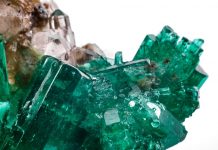
  • Poor: Six-inch emerald crystal
  • Good: Chromium ions give this 6-inch emerald crystal its deep green color.
  • Poor: The finished “S” element
  • Good: Twist a circle into the end of the wire, then form the S shape by stretching the wire across your index finger.
  • Poor: The author digging gems at the rocks at the Pitt mine.
  • Good: The decomposed shale is easily broken apart with a pick so the crystals can be removed.

These are very generic examples, but as the expert on your topic, you can include specific information that our rockhound readers will want to know. For more examples of Rock & Gem’s caption style, pick up any copy of the magazine. Read the captions and copy the style.

Please remember the following when writing captions:

  1. Captions must be typewritten; handwritten captions are not acceptable. Type your captions at the end of your article or in a separate file on your CD or memory stick.
  2. Number your color prints to match your captions; use filenames to match captions to digital photos.
  3. Give a separate caption for each photo, even if several photos are similar.