
Zoisite is a versatile mineral that occupies a unique place in the world of lapidary materials and gemstones. Found most often as a massive mineral, it is best known for its striking red-and-green ruby-zoisite combinations, its carved decorative uses, and its role as the parent mineral of the gem tanzanite. Few minerals display such a wide range of colors, forms, and applications.
First introduced to the collecting and lapidary community in the mid-20th century, zoisite attracted immediate attention through material recovered in East Africa. The distinctive green host rock, frequently containing sharply formed red ruby crystals, proved abundant and highly workable. Its bold color contrast and durability made it especially appealing for cabochons, carvings, and ornamental pieces, quickly establishing it as a staple in lapidary shops and mineral collections.
Ruby Zoisite: A Striking Natural Combination
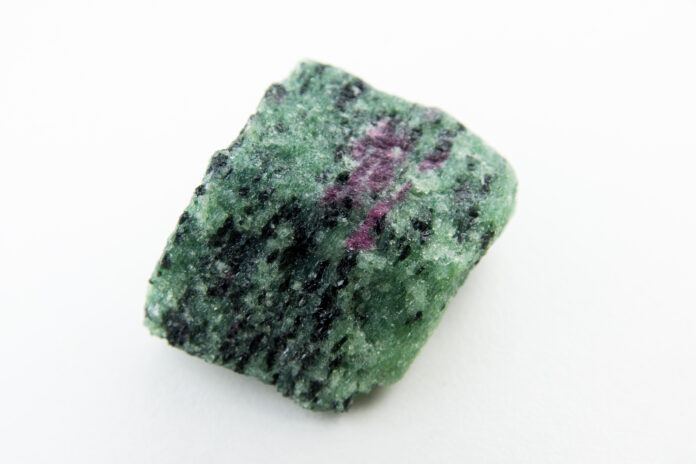
Massive varieties are typically green and slightly granular in appearance, but their most visually dramatic form occurs when vivid red ruby crystals are embedded within the green host rock. These rubies commonly appear as well-formed hexagonal crystals ranging from opaque to translucent, sharply contrasting with the surrounding zoisite. Scattered throughout the material are small black spots and needlelike crystals, once identified as hornblende, adding a third color element to the stone.
Some ruby terminations reach several inches across, and where the crystal ends are exposed, and slightly translucent, polished domes can display a subtle chatoyant shimmer. Although free-standing ruby crystals are absent, the natural red-and-green pairing proved immediately attractive to lapidary artists.
Discovery and Early Mining in Tanzania
The discovery of zoisite-ruby rock happened in 1949 when an English prospector named Tom Blevins worked in Tanzania. While prospecting, he came across a deposit of large opaque ruby crystals. He immediately staked claims — in hopes he could make a fortune if some of the rubies proved to be gemmy and could be cut. However, luck was not on his side.
The deposit was part of a substantial regional metamorphic area composed mainly of schists and marble formations. Mining commenced on the deposit in hopes that deeper mining would reveal gem crystals. That did not happen.
Ruby Zoisite Mining in Tanzania
However, mining of the deposit did prove fruitful, with the discovery of the red-green gemstone combination in 1954. Soon after the discovery, the material was marketed as excellent for cutting rough. Before Blevins’ discovery, the local Maasai tribe was aware of the deposit and called it anyoli, which means “green stone.” Even now, you may come across that name on an older specimen of zoisite-ruby rock. Today, some 70 years after its discovery, the Tanganyika ruby-zoisite deposit is still the only major source for this lovely carving material. Kenya has produced some, but in limited amounts.
As time has passed, not only has the name of the country where the zoisite-ruby combination was found changed, but so too has the name of the black mineral often found in tandem with the green-red beauty.
Tanganyika, like so many African countries, was under colonial rule in the early 19th century. When Europeans took over the governing of Africa, the zoisite region of Tanganyika came under the control of the Germans as part of German East Africa. This rule lasted until Germany’s defeat during World War I — when the British took control and managed the area — until World War II came to an end. After that war, control of the region brought another name change when placed in the United Nations’ hands as a trust. Then, in 1964, the area that had been Tanganyika was merged with Zanzibar and became the United Republic of Tanganyika and Zanzibar. Later, the Zanzibar name was dropped. Today, the primary zoisite-ruby source is the United Republic of Tanganyika.
Zoisite in Popular Culture
Zoisite has appeared beyond mineralogy, lending its name to a character in the early-1990s Japanese anime series Sailor Moon. In the show, “Zoisite” joins other characters named after minerals, including Jadeite, Kunzite, and Nephrite. The storyline follows their charge to protect Prince Endymion, though characters occasionally transform due to negative energy from the Dark Side. Other mineral-inspired names, such as Hematite and Silver Crystal, also appear. While entirely fictional, the use of this mineral in popular culture demonstrates the broad fascination with minerals and their evocative qualities.
HERITAGE AUCTIONS
Zoisite Varieties and Lapidary Uses
Beyond fiction, zoisite occurs in many localities and forms, ranging from colorless to yellow, green, green-brown, pink, blue, and purple. Its massive forms are prized for carving and cabochons, while crystallized specimens can display striking colors. The pink massive variety, called thulite, is best known from Norway and Austria, and the green material from Africa is favored by lapidary artists. The most valuable crystallized form, tanzanite, occurs in blue-to-violet crystals in the Merelani Hills of Tanzania. Discovered in 1967, tanzanite quickly became a world-class gemstone, prized for its color, rarity, and association with its parent mineral.
Tanzanite: A Modern Gem
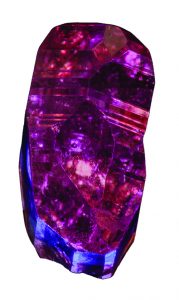
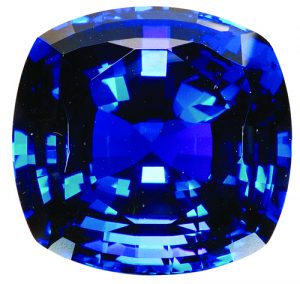
Tanzanite, a blue-to-violet variety, was discovered in 1967 in the Merelani Hills of Tanzania. The first crystals were brought to the U.S. by geologist Campbell R. Bridges and introduced to the market by Tiffany & Co., which quickly promoted the gem as something new and exceptional. Its striking color, rarity, and value have made tanzanite one of the most sought-after gems, rivaling many rubies and sapphires, with only diamonds, deep blue sapphires, and the rarest rubies commanding higher prices. Most tanzanite today undergoes heat treatment to remove brownish hues, producing the classic blue-violet color while slightly affecting the mineral’s natural trichroism—its display of three permanent colors from different crystal angles.
MINERAL TRUST GEM
Thulite and Ruby-Zoisite in Lapidary
Other massive forms also hold lapidary appeal. Thulite, sometimes called rosaline for its pink color, is found primarily in Norway and Austria and is prized for carving and cabochons. It does need to be protected when mounted, as it has a hardness between two and three on the Mohs scale. It is compact, slightly granular, and is usually spotted white by included calcite, and the shades of pink are undoubtedly due to manganese substituting for calcium.
Ruby-zoisite continues to offer striking red-and-green material, ideal for decorative pieces, despite occasional inclusions of black hornblende needles. The bold natural color contrast of ruby-zoisite and the unique shades of thulite make both varieties favorites for artists creating memorable carvings and jewelry, particularly for seasonal or thematic designs.
Zoisite: FAQ
Q: What is zoisite?
A: This mineral is found in massive and crystallized forms, ranging in color from green and pink to blue and violet. Varieties include ruby-zoisite, tanzanite, and thulite.
Q: Where is zoisite found?
A: The primary sources are Tanzania for ruby-zoisite and tanzanite, Norway and Austria for thulite, and limited occurrences worldwide for other color varieties.
Q: What is ruby-zoisite?
A: Ruby-zoisite is a green zoisite host rock containing embedded red ruby crystals, prized for cabochons, carvings, and decorative lapidary pieces.
Q: How is tanzanite related?
A: Tanzanite is a blue-to-violet crystallized variety of zoisite found in Tanzania. It is highly valued as a gemstone and often heat-treated to enhance its color.
Q: What is thulite?
A: Thulite is a pink massive variety of zoisite, mainly from Norway and Austria, used for carving and cabochons in lapidary work.
This article was written for Rock & Gem magazine. Click here to subscribe. Story by Bob Jones.